




Albania is experiencing the most important event in the history of its resistance against a deeply corrupt, criminal and arrogant political class. Its most prominent representative, Prime Minister Edi Rama, could hardly have imagined that it would be a shady deal with Jared Kushner that would provide the spark for the protest against his regime. The deal involves building luxury tourist resorts on Albania’s Adriatic coast. This threatened a protected wetland that is home to thousands of flamingos.
Albania is a country with a high level of trust in the US, and Rama knows very well how to play the ‘American card’. He presumably thought that the involvement of an American, especially a member of the Trump family, would be enough to convince the public that the project would be another success. And that would further consolidate his omnipotent image. The anger and despair had been building through the prolonged transition, but it was this deal that made the protest erupt.
From social anaemia to rebellion
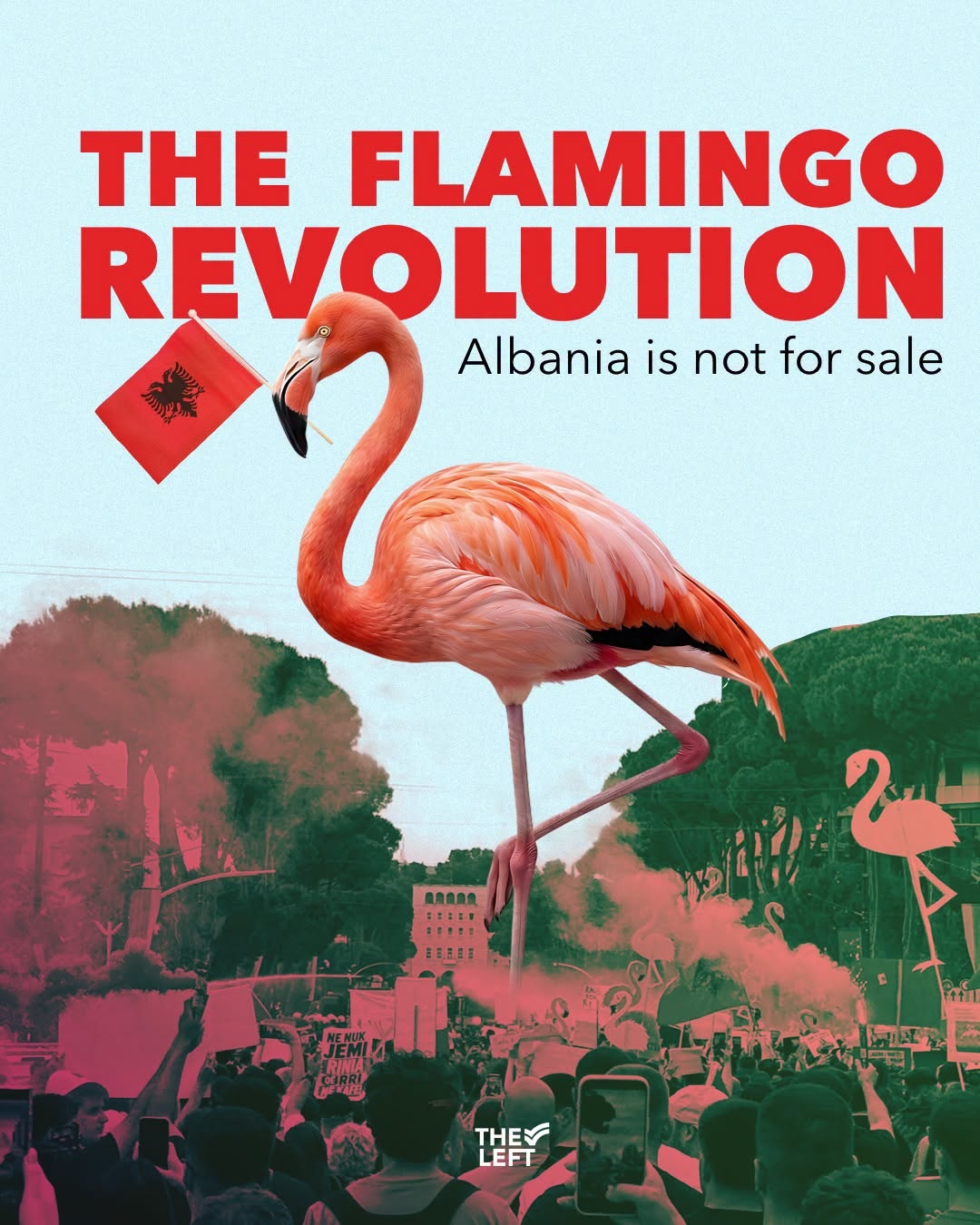
One of the clearest pillars of this platform is an immediate halt to the destruction of public spaces, captured most powerfully by the message “Albania is not for sale”. (Photo: Borderless)
The significance of this popular protest, which began at the end of May 2026 and has continued every day ever since, cannot be overstated. It emerged amidst a remarkable, decades-long absence of social movements and organisations, as well as democratic practices. This is largely due to the extreme atomisation of society under Enver Hoxha’s totalitarian regime. The introduction of the market economy in the 1990s reinforced this atomisation by promoting rampant individualism.
The diagnosis was clear: the country suffered from a profound, irreversible weakening of its social fabric. No collective resistance was to be expected, at least for the foreseeable future. Understandably, a protest of this magnitude and duration has shocked society, and this explains why it was dubbed the Flamingo Revolution.
But it should not be so shocking; pockets of resistance have often been mobilised with the support of a core group of activists who have spent almost 15 years organising workers and students. Many of them are, or have been, involved in various ways with what is now known as the “Together Movement” (Lëvizja Bashkë) political party. Their efforts culminated in the 2018-2019 Student Movement protests. In fact, many of those joining the current protest were also part of the 2018-2019 student protests; significantly, many of them, unlike possibly half of the Albanian population, have chosen to remain in Albania rather than emigrate.
Regardless of what the coming days and months may bring, this protest has irreversibly changed the public discourse, the alignment of political forces, and perceptions of social activism in the country. It has also created a space for debating the perspectives for a broad-based movement for social change.
One protest, different political meanings
The Albanian protest shares similar features with many of the protests that took place in the period 2010 – 2020. In an interview with Jacobin in 2024, Vincent Bevins describes the decade of protests as spontaneous, leaderless, horizontally organised and digitally coordinated. Like those protests, in Albania too the square is open to everyone, resulting in a wide variety of issues and demands that people bring to it. As a result, although such protests are fundamentally forms of reaction to injustices, they are at the same time very difficult to decipher.
In the case of Albania, what unites everyone in the square is a powerful revolt against Rama’s corrupt and arrogant regime and the propaganda industry that supports it. Yet, there are at least three broad groups, with three different ideological axes, each giving the protest a different political meaning.
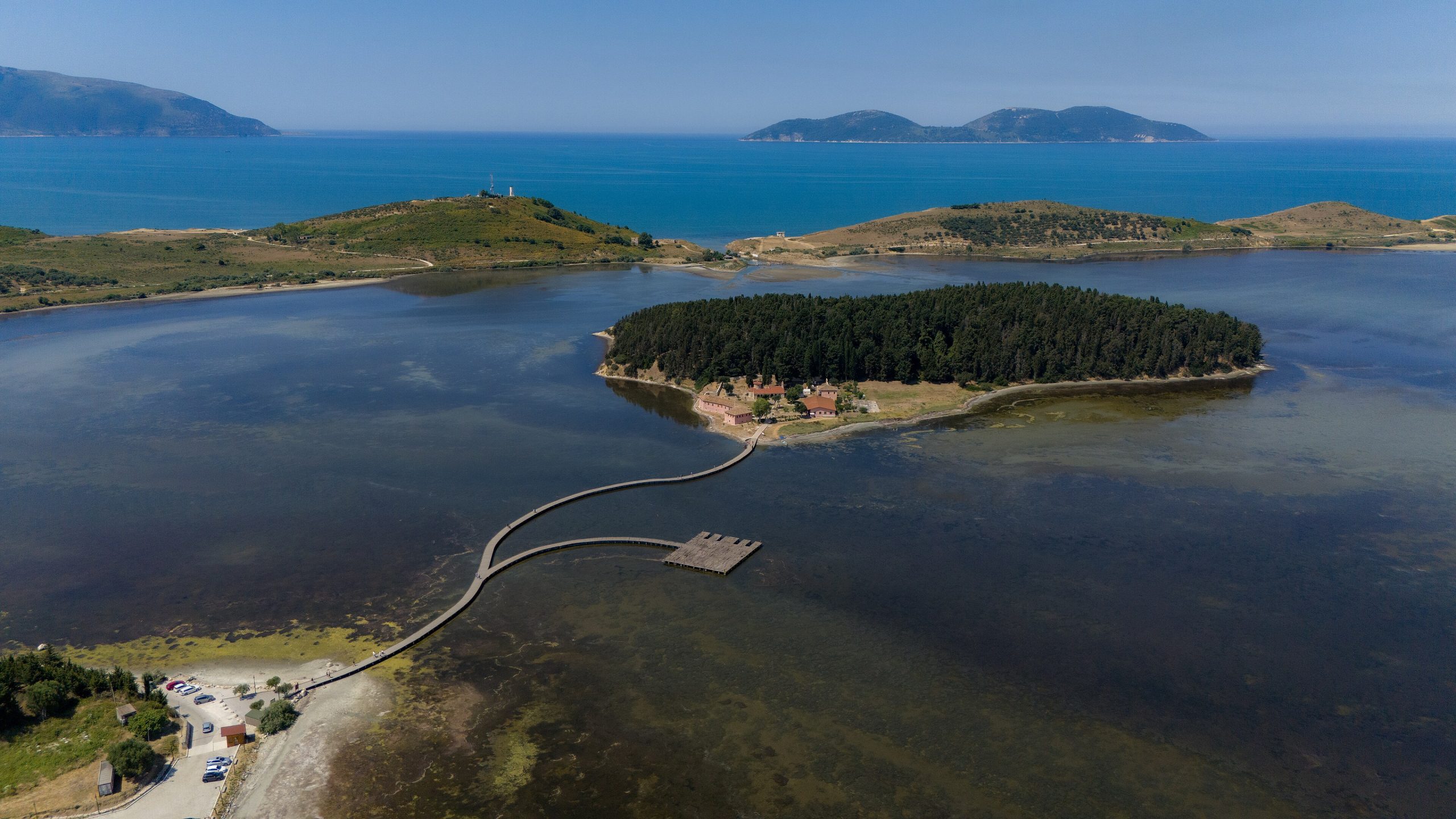
The island of Zvërnec in the Narta lagoon; Sazan island is on the horizon. It’s the site of Jared Kushner’s proposed €1.4 billion luxury resort; the shady deal that would provide the spark for the protest against Rama’s regime. Photo: Arben Llapashtica/Wikimedia Commons (CC BY 4.0)
The free-marketeers: The first group brings together free-market economy supporters. For them, the problem with the Jared Kushner affair is not the shrinking of public spaces and the destruction of nature. It is the opaque way public land is handed over to businesses connected to Rama to consolidate his power.
They are not so different from Rama in seeing the transformation of nature and public spaces into luxury towers and resorts as ‘development’. They see protection of the environment as a secondary issue or even just a matter of aesthetics. Like the World Bank during the transition of the former Soviet Bloc countries, they see corruption as beginning and ending with the state. The private sector is merely a victim. Left unconstrained, it delivers the best outcome for society.
In this sense, the ideas of this group overlap substantially with the neoliberal policies of post-1990 governments, perfected by Rama since 2013. According to this perspective, corruption is a matter of crooked individuals. They maintain this even though any serious analysis of the most blatant corruption cases in Albania shows that they have been conceived and carried out through close cooperation between the business elite and the government.
The nationalist right: The second group combines nationalist ideas, often of a reactionary character, with various conspiracy theories, especially about the threat of the Soros agenda, globalisation, Marxists, communists and Islamists. The goal of those who inspire this group is not to develop an in-depth or logical analysis of the systemic conditions in the country. It is simply to stir up emotions and build support for their ideas. Some individuals and factions within this group oppose any causes beyond Albania (e.g. opposition to the genocide against Palestinians) in the name of nationalism. However, ironically, they completely appropriate the typical language and ‘arguments’ of far-right movements in other countries.
Challenging the neoliberal hegemony: The third group bases its position on an in-depth analysis of Albania’s political economy. For nearly four decades, the political class has pursued a project that combines the dispossession of citizens from public spaces and destruction of nature with extreme exploitation in the workplace. This is all done in the name of a ‘development’ model that unsurprisingly benefits the interests of the national and international oligarchy (it is largely thanks to the BASHKË Movement that analysis of politics in terms of the power of the oligarchy has become normalised in Albania).
This has resulted in flagrant violations of citizens’ constitutional rights to essential services (healthcare, education, housing, food, clean water and air). It also violates workers’ rights to fair wages and working conditions and to organise collectively. In this analysis, big businesses are not victims; they use the state to maximise their profits from every segment of the economy. They insatiably exploit workers and nature, destroying both in an irreversible process. This, of course, involves hefty bribes for government officials, which in turn are used to consolidate political power. In this analysis, corruption is part and parcel of the system.
This group, which offers a comprehensive analysis that dismantles and delegitimises the ‘developmental’ model of the past (almost) four decades, also has the potential to envisage a political project that provides the best chance to overcome it. If we can speak of a revolution in the sense of radical change, this is the most representative group of the Flamingo Revolution – a term originally coined by activists of the group. Finally, for this group there is a strong connection not only with similar protests and resistance elsewhere, but also with the most important issues of our time, such as solidarity with the Palestinian people and condemnation of genocide.
Many of the elements of the analysis by the third group would be acceptable also to individuals in the second group. In the absence of an in-depth political and economic analysis, they rely on simple explanations, especially in the form of conspiracy theories. This is not to deny that there are individuals among them who insist on these theories with the clear aim of pushing the political agenda of the far-right, while at the same time they fight the most prominent groupings and individuals of the third group.
The battle for the future of the country
This article offers a reading of the protest as a popular, deeply political rebellion against the systematic plundering that the unholy state-oligarchy alliance has inflicted on the country. This painful transition has had very severe consequences for the people, for nature and for the future of the country.
So, what are the prospects of building a broad-based social movement for social change in this context?
The third group is of vital importance to the country. It is precisely the political message of this group that has managed to channel the deep social despair and anger into a revolt against the political class and the country’s elite. The potential for the far right to capitalise on this discontent, as it has elsewhere, was and remains significant, especially given the greater prominence some of these elements have recently shown. At the same time, the group has generated an extraordinary creative energy, both in terms of political art and practices of collective care. In this sense, this is the worthiest representative of the Flamingo Revolution.
The group, however, is far from a solid bloc; it is highly diverse, and over the years there have been several episodes of tensions among activists. And yet, since the start of the protest, they have shown a level of maturity that may help to overcome these tensions going forward. This is especially because it has given them the energy and the language to express a political platform that resonates with the hopes of many who have joined the protest or support it from a distance.
Reclaiming nature and rights
One of the clearest pillars of this platform is an immediate halt to the destruction of public spaces captured most powerfully by the message “Albania is not for sale”. The development of plans to reclaim these areas should include a re-conceptualisation of cities that addresses the ecological crisis. Another vital pillar is the strengthening of quality public services to guarantee constitutional rights and freedoms (clean water, air and cities, housing, healthcare, education, transportation).
The political objective should be to remove society’s vital infrastructure from the logic of commodification and profit maximisation. Those defined as constitutional rights cannot be part of schemes for financial gain; otherwise, they are no longer rights but privileges for those with financial means.
In pursuit of this political objective, the organisations and individuals of the third group could follow two parallel tracks. They could gather in a joint assembly to set the parameters of cooperation and discuss common strategies and tactics. At the same time, they could continue their activism in accordance with their political perspectives.
The critical role of democratic and independent trade unions
One final reflection: as Bevins observes, in the few instances when the decade of protests has been successful, trade unions have played a key role. The existing unions in Albania are deeply corrupt and authoritarian formations. Building genuine unions in the country has proven exceptionally difficult. Efforts to organise democratic trade unions have been met with repression from employers, strongly supported by the state and, of course, the existing unions.
But perhaps, just as the Flamingo Revolution overturned strong perceptions of social apathy, it is possible to imagine a similar upheaval in workers’ organisations. This will require an understanding of the working class based on two criteria:
- It includes all those whose livelihood depends on the ability to sell their physical and mental capacity to work. The formal contractual relationship is far less important than the total control by employers of both what these workers produce and how it is produced. What has been normalised in this system of control is a world of work where employers have undisputed authority, often at extraordinary physical, mental, and emotional cost to workers.
- It sees that workers are also citizens who suffer the consequences of a corrupt and authoritarian government. Thus, the vast majority of the tens of thousands of protesters who have filled the squares of Tirana and other cities should also be seen as workers in the broad sense of the term.
The difficulties faced by consolidating the third group into a broad social movement are enormous. The country, however, is on the brink of an abyss. The trajectory of the third group will determine not only how this popular rebellion is going to be recorded in the country’s collective memory, but also its future: towards an extreme right-wing authoritarian regime or towards a political project of hope that is anchored in ideals of freedom, equality, justice, human solidarity, and care for our shared home – the planet Earth.
Edlira Xhafa is an Albanian labour activist. She is the Executive Director of the Online Academy of the Global Labour University (GLU). A graduate of the Master programme at the GLU-Germany, she also holds a PhD in Labour Studies from the University of Milan, Italy. Her recent research focuses on labour at the intersection of far-right authoritarianism and ecological crisis, democratising public services, and other topics.
*Featured Image from Albinfo/Wikimedia Commons (CC BY 4.0)



