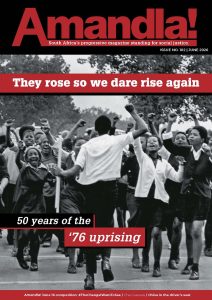

The Soweto uprising stands as a poignant reminder of the young people who rose against oppression and paid the ultimate price in the liberation struggle. It was a pivotal moment in South African history. It reignited the struggle against apartheid and resuscitated the broader liberation struggle. Thousands of youths from various black residential areas mobilised in solidarity with their Soweto counterparts.
However, most of the existing literature tends to concentrate on major urban centres such as Johannesburg and Cape Town. This paper focuses on an area usually ignored in discussions of anti-apartheid activism: Galeshewe in Kimberley, Northern Cape.
The Soweto uprising had a ripple effect in Kimberley. After three months of relative calm, partially due to the June academic recess, unrest suddenly broke out among Galeshewe students on 2 September 1976. The scale and intensity of these demonstrations were not comparable to the Soweto uprising, given the smaller population in Kimberley and Galeshewe. But, for the individuals who participated in this protest, it was their way of contributing to the fight against apartheid.
Significance
The Galeshewe student uprising made a significant contribution towards the liberation struggle. However, its role is tainted by omissions and has somewhat slipped through the cracks of history. This is partly because Kimberley’s Black community has always been regarded as conservative and out of the reach of mainstream media. For the same reason, the apartheid government decided to place Robert Sobukwe under house arrest in this area. However, this perception does not do justice to the sacrifices made by the people of Kimberley during times of resistance against apartheid.
This paper examines the relationship between structural forces, such as the oppressive apartheid laws, and the agency of students (particularly those in Galeshewe) in fighting against these forces.
Causes of the uprising
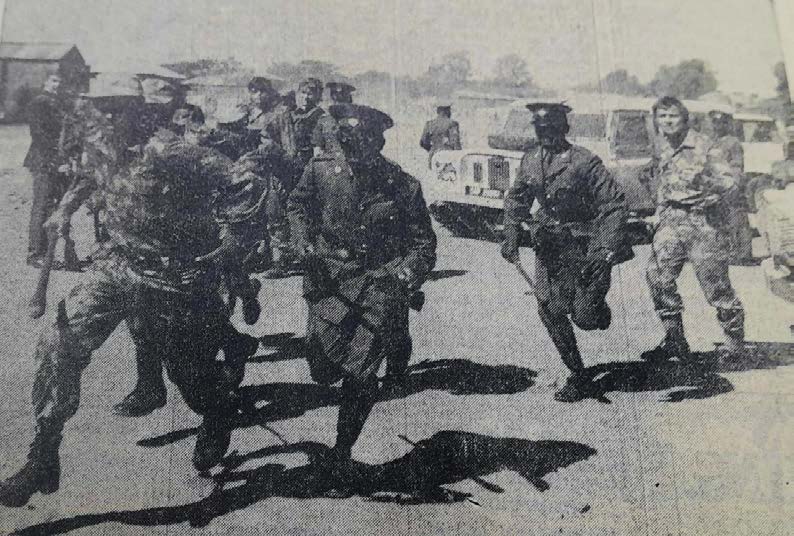
The security police moved decisively into the township, employing intimidation, multiple arrests, and heavy patrolling to dismantle student resistance.
Many writers champion the notion that inferior and oppressive education was pivotal in the development of the protest. Bantu Education meant poor infrastructure, overcrowded classrooms, and an inferior curriculum. These conditions, coupled with other socio-economic grievances, intensified students’ resentment and hostility towards the apartheid state. Ultimately, they created a conducive environment for resistance.
The 1976 Galeshewe uprising reflects similar dynamics. Galeshewe student demonstrations were driven by the dehumanising conditions that they were subjected to under the Bantu Education structure. This educational system was characterised by structural conditions that ultimately became the main driving force behind the demonstrations.
In addition, the rapid expansion of schooling in the 1970s turned classrooms into political spaces where students shared ideas, developed a collective consciousness, and began to challenge the status quo. As more African youth entered secondary schools, these spaces evolved into hubs of resistance. Between 1970 and 1978, additional primary and secondary schools were constructed in Galeshewe to accommodate the tremendous student population. Students transformed schools into spaces of political awakening. Schools became a rite of passage where students shared ideas that nurtured a collective consciousness. Schools were structures that were initially built to uphold apartheid’s control over the African population. Students turned them into tools of resistance.
What happened in Galeshewe
On 2 September 1976, several students from St. Boniface embarked on a protest, pelting a beer hall. Beerhalls were seen as destructive for the entire Black community. The change in political ideology and the spread of Black Consciousness made young people aware that such establishments were meant to derail the Black community. Students viewed the establishment of beerhalls as an attempt by the apartheid government to dismantle the Black family structure. So, to demonstrate their frustration with societal grievances, students used them as a point of reference to express their anger. Five beerhalls were petrol-bombed as an act of resistance against the system of oppression.
Five students were detained after this incident. Among them was Sipho Majola. Majola and his comrades were charged with incitement and contravening the Terrorism Act. Majola was only 19 years old during the time of his arrest, doing Form 5 (grade 10) at St. Boniface Catholic School. He had already been politicised through contact with Robert Sobukwe in Kimberley. Sobukwe, the founding president of the Pan Africanist Congress (PAC), made major contributions to the foundations of political conscientisation in Galeshewe during his house arrest there.
Majola was one of the few individuals who had regular contact with Sobukwe during his banishment in Kimberley. As a result, Majola emerged as a central organiser of the protest in Galeshewe against inferior education, in unison with counterparts across the country, in the aftermath of the Soweto uprising.
On 3 September 1976, more than 200 students from St. Boniface Mission School and Tshireleco High School embarked on a peaceful march to the Transvaal Police Station (now known as the Phakamile Mabija Police Station) singing “Nkosi Sikelela i-Africa!” and holding placards that read “We want Sipho!”. They were the first Black students to march to a white police station in the country. Their march symbolised a powerful breakthrough in the liberation struggle. The Soweto students had a huge impact in inspiring Galeshewe students to actively fight against oppression.
Interestingly, halfway through the students’ march to the Transvaal Police Station, Brother O’Brian, the principal of St. Boniface Mission School, was seen speaking to them. He assured the crowd that he sympathised with them. He further encouraged them to focus on the upcoming examination. He mentioned that he hoped that Majola would also write the exam. Lastly, he urged the crowd to disperse peacefully while the police kept a watchful eye on the students’ gathering. Brother O’Brian’s statement, which aimed to calm the protesting students, was probably an attempt to prevent a situation that could have erupted into violence.
The resistance continued
Nonetheless, acts of resistance did not dissipate in the aftermath of the initial protest. They persisted, including stone-throwing and arson that erupted across Galeshewe. For instance, the open-air sports arena’s boxing ring was set alight. These actions unfolded concurrently in different parts of the township, reflecting a continued, though less coordinated, defiance against state repression.
The security police moved decisively into the township, employing intimidation, with multiple arrests, and heavy patrolling to dismantle student resistance. For example, on the morning of 10 September 1976, the township was showered with pamphlets warning residents not to participate in any riotous activity. The pamphlets were dropped from a light aircraft. They cautioned residents that they would have to pay to repair any damage sustained during the unrest. There was no riot or civil disturbance insurance coverage on properties in Galeshewe. Therefore, Galeshewe residents would bear the cost of repairs should any property be destroyed.
This was a clear attempt by the authorities to discourage participation and dismantle the student protests by instilling fear of financial consequences. The circulation of these warnings, likely linked to the security apparatus’s intensified presence, contributed to a climate of heightened fear and caution, further curbing overt resistance.
On 16 September 1976, the Diamond Fields Advertiser reported that Majola and several others were released on R200 bail after a brief appearance in the Kimberley Regional Court, with the case postponed to 18 October 1976 and no plea required. However, oral testimonies collected during this research challenge this account. According to Lentikile Mattews, while some students, including Joseph Rakubo, were released, Majola remained in police custody until November and completed his matric examinations while imprisoned at the Transvaal Police Station.
Following his release on bail, Majola fled the country to Botswana, becoming a fugitive at a young age. He was likely to face a severe sentence because of his involvement in a banned political organisation and violation of the Riotous Assembly Act.
Following police repression and intimidation, the 1976 Galeshewe student uprising became dormant, as key leaders were taken into police custody
The lessons remain relevant
Galeshewe students resonated deeply with the course of the Soweto students’ revolts, which inspired them to take an active stand in the fight against oppression. Although their resistance was short-lived, it reminds us that townships like Galeshewe are not merely footnotes in the liberation struggle. They were crucial to its making. Recovering these histories is about recognising the agency of communities whose contributions have long been overlooked.
Today, South Africa grapples with significant educational inequality and other social injustices. The experiences of 1976 remain strikingly relevant. The structural conditions that pushed students into the streets have not entirely disappeared. Nonetheless, the legacy of Galeshewe student activists lies not only in what they did, but in what they represent: a reminder that even in places deemed politically unconscious, resistance can emerge and challenge the status quo.
Happy Vena is a Master’s student at Sol Plaatje University and an emerging historian committed to uncovering marginalised histories.