




On November 5th, 2024, Donald Trump was re-elected the President of the United States. This comes just four years after his loss in the 2020 presidential election to Joe Biden culminated in the insurrection that he helped instigate. From the outside looking in, it is perfectly reasonable to ask how over 76 million Americans could vote for a convicted criminal, insurrectionist and proud authoritarian strongman.
Pundits have provided several explanations, including inflation, racism, and an uninspiring Democratic candidate in Kamala Harris. In terms of demographics, white men and women, who comprise roughly 71% of the US electorate in the most important states, voted overwhelmingly for Trump over Harris. Democrats lost the vote of those who make under $100,000 (R1.9 million) and those without a college degree.
As we continue to learn more, it seems clear that the working class in this country voted for Donald Trump.
People feel poorer
Arguably, the strongest argument for why Trump won is a simple one: people’s lives in the US did not get any better under the Biden/Harris administration. According to an exit poll, almost 50% of survey respondents said their family is in a worse financial situation today than they were four years ago. 81% of those who gave that answer voted for Trump. Nearly 70% of people said the economy is either poor or not so good. The purchasing power of the average American decreased by 2.46% in just this last year.
The American people felt angry, unrepresented and isolated from US politics. They wanted change.
Despite being the richest country in the history of the world, millions of Americans struggle day to day. 70% of Americans live paycheck to paycheck, with monthly bills like rent or energy significantly contributing to this insecurity. Over 27 million people don’t have health insurance and even those who do report poor coverage. In addition, student debt is at all-time highs, current levels of income and wealth inequality are unprecedented in modern human history, and climate change-induced disasters are displacing people in the US and elsewhere. Taking all that into consideration, it becomes understandable that distraught people would find hope in Donald Trump or sit out the election altogether.
No matter how the mainstream media pundits try to portray it, Americans economically are struggling and desperate.
Democrats have no answer
This poses a real problem for the Democratic Party. They do not have an answer to the hurt of the American people. This hurt may be even more pronounced if we look at the youth. Typically, young people are taken for granted as a strong Democratic vote. And while young people still did vote more Democrat than Republican in 2024, the lack of enthusiasm for either candidate, especially Harris, seemed to be the driving force for the lack of a major youth turnout. Youth voter turnout dropped to its lowest levels since 2016. In 2024, young people gave the Democrats only a 6-point margin in their favour compared to 2020, when it was +25. Young men voted for Trump by 14 points in 2024, reflecting a more general trend of young men shifting rightward both in the US and globally. And while young women still voted for Harris by 7 points, their share of the Democratic vote decreased compared to 2020.
These gender dynamics are helpful, but they only provide a partial explanation. Fewer eligible young voters showed up in 2024 than in 2020. Harris had a significant drop, but even Trump only managed to get a 1% increase in the youth vote compared to 2020. This was not an ‘anti-woke’, ‘young people moving to the right’ election; it was a ‘we are going to sit this one out’ election.
A youth perspective
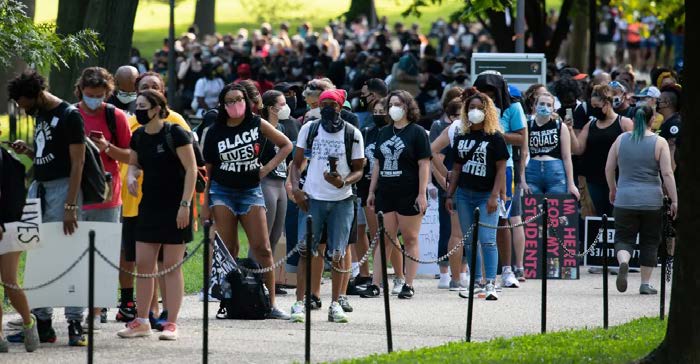
According to a national survey earlier this year, “Young voters do not look at our politics and see any good guys. They see a dying empire led by bad people.”
It is helpful to examine how young people view American politics to better understand the lack of turnout. Young people are much less likely to identify with a party; they feel unrepresented by either the Democrats or Republicans. In addition, they are more issue-oriented than older generations. As Tufts Circle, the leading authority on the youth vote in the United States, noted about the 2022 mid-term elections, “In this and in every election, many young people were motivated to vote because of the issues they care about.” Abortion, the economy, and climate change consistently rank as young people’s top issues. When parties or politicians don’t speak to the issues young people care about, they do not resort to the ‘lesser of two evils’ or ‘vote Blue no matter who’ thinking of committed Democratic voters. Young people are not convinced.
According to a national survey earlier this year, “Young voters do not look at our politics and see any good guys. They see a dying empire led by bad people.” Increasingly, they think that there is no major difference between the two political parties, that no matter who wins, it won’t make a substantial difference in their lives, and they have less and less trust in our institutions. And their pessimism is perfectly warranted, given the confluence of climate crisis, inequality and unrepresentative liberal democracy.
And now?
The election is over, so we are left with the most important question: where do we go from here? As the old saying goes, crisis and opportunity go together. For one, there is an increasing recognition that liberalism is a dying breed. For all the talk of Joe Biden representing the “end of neoliberalism”, his campaign and Harris’ did not provide any convincing path out of it. With so many Americans angry and disillusioned with the system as it is, there is a real opportunity to provide a vision and ideological framework that names an enemy, speaks to people’s discontent and provides for their material conditions. This might mean, at the very least, running campaigns with platforms and messaging closer to Bernie Sanders than Joe Biden. There are now multiple elections where progressive policies performed better than the Democratic candidates. In this election, many ballot initiatives and Left populists won despite Harris. There is even some elite liberal recognition that “maybe Sanders had a point.”
But beyond campaign platforms or messaging, the US’s problems run deeper, and responses will have to rely on extra-electoral strategies. Historically, trade unions and vanguard parties have filled this space. The most obvious is to continue to build the labour movement that has had a recent resurgence. Young people, in particular, often considered the most ‘pro-union generation’, will be vital in keeping this momentum, building militant unions in the face of authoritarianism around societal issues that go beyond just wages and benefits.
This is not the time to get apathetic, to despair, or for America to think it is extra special. People here and abroad have had a long history of fighting fascism, authoritarianism, and apartheid, and came out in the end. We must relearn and relive this history in order to fight forthcoming fascism. As Kelly Hayes and Mariame Kaba remind us in their book, Let this Radicalize You, “organizing is the antidote to despair.” The fascists are getting organised; we must too.
Andrew Ahern is the Youth Climate and Organizing Program Manager for the 128 Collective: a family foundation that seeks to democratically and publicly own climate change assets in the US and internationally. You can follow him on Blue Sky at: andrewonearth.

