

What do we mean by green colonialism? I think whenever we discuss questions of energy or climate change or land or fisheries or the economic system, we need to have an anti-systemic analysis. When we have a robust, correct analysis of how capitalism works, how it reproduces itself, the various dynamics in North and South, we can start reflecting and imagining alternatives. But this starts with analysing how capitalism works, its inner workings.
So, what do we mean by green colonialism? For me, it’s the extension of the colonial relations of domination, plunder, exploitation, and theft of resources, as well as the dehumanisation of the other, to the period of renewable energy, conservation and sustainability. Capitalism works through externalising costs to others: to women and carers through largely unpaid social reproduction work, to rural areas, to black and brown bodies in the South, and to nature by commodifying it, dominating it, treating it as a commodity to be traded. And that’s exactly what caused the climate and ecological crisis.
Colonialism cannot, for me, be dissociated from a discussion around capitalism and imperialism. Green colonialism means that the priorities of one part of the world—the richest part of the world, the centres of empire—in terms of energy, in terms of environment, in terms of water come at the expense of another part. That part is what we call the periphery, or the Global South.
When we talk about energy, the global transition, the green transition that the mainstream media and the ruling classes are talking about, it is not really a transition. Renewable energy is not effectively or significantly displacing fossil fuels from our energy systems. What we are seeing is fossil capital and green capital running in parallel, intermeshed together. And very often, the fossil fuel companies are the ones investing in renewable energies—TotalEnergies, BP, Shell—trying to dominate the new green value chains. So it’s not just a greenwashing exercise, although it serves that function — they can pretend that they are doing something for the environment. It’s much more than that.
The capitalist road
But let’s suppose that there is a kind of a transition towards renewable energy. In the capitalist system, there is an energy-intensive production and consumption pattern (mainly in the Global North but also in the richest pockets of the Global South). To maintain this system, we would need a lot of resources. For some rich people to be able to drive one car or two, feel good about their livelihoods, consuming green, eating organic stuff, and doing their bit for the environment, that means a lot of extraction. What that extraction needs is the critical raw materials (copper, lithium, cobalt, nickel, graphite) for the energy transition, but also for other usages—militaries and wars, high tech, AI and so forth.
The question that we need to ask ourselves is, where would these resources come from? In the majority of cases, those resources are concentrated in countries of the Global South, like the Democratic Republic of Congo, where another genocide is taking place where children are exploited in the mines. So, to maintain the same mechanism means more extractivism, more sacrifice zones, more disruptions, also in other countries in Latin America, the lithium triangle (Chile, Argentina, Bolivia), but also Indonesia, Myanmar, Zambia, and other countries who have those resources.
What we are seeing is those plans for what is called sustainability and the green transition are dictated by the richest and the most powerful, either in terms of class or in terms of nation. So in North Africa, for example, many projects are being designed to export green electricity to Europe regardless of the energy self-sufficiency and sovereignty of the local people, regardless of who owns the land or who uses it, regardless of questions around water poverty.
And when I talk about water poverty, I think about green hydrogen. There is a lot of talk about green hydrogen. Green hydrogen requires a lot of water. For countries in North Africa that suffer acute water poverty, it doesn’t make sense to produce green hydrogen for export. That’s why we talked about neocolonialism and colonialism. But colonialism and neocolonialism are just expressions of imperialism, and imperialism is a dynamic expression of the capitalist expansion all over the world.
The example of Palestine
And when we talk about green colonialism in the Arab region, I think the first example that comes to our mind is Palestine, where the settler colony of Israel is presenting itself as this environmental steward, a green champion, providing some kind of technologies in desalination, water, agro-business, renewable energy for the neighbours and other countries, while greenwashing their colonial crimes. That orientalist, colonial environmental narrative is not new. It has been used since colonial times. I believe it was developed by the French in my home country, in Algeria. It presents that kind of environment as alien, degraded, abnormal, needing some kind of intervention by the white man: the civilising mission.
And that narrative has been used by the Israelis to justify their settler colonial project. Not everything is colonial, but it might be a useful framework to describe some of the dynamics around what we are talking about in the name of the green transition.
So what is the just transition?
The just transition is a contested term. It began as a grassroots, militant concept and framework that came about through the convergence of three movements: the labour movement, the environmental justice movement, and the indigenous communities movement in the United States, fighting the chemical industry. These movements understood and fought the divide and rule strategies of the industrial capitalists, the polluting industries. They said, we need to unite in the face of one system, which is the capitalist extractivist system that is destroying the environment, confiscating the land from indigenous communities and exploiting the workers at the same time. So that’s the origin of that concept.
Now that concept has been hijacked, has been co-opted. But it’s not unique. ‘Democracy’ has been hijacked; ‘climate justice’ has been hijacked. It doesn’t mean that we should abandon those terms. It means that those terms and frameworks are a terrain of struggle. They are ground that we need to claim back, to recapture those concepts and frameworks and politicise them, give them our radical meaning, our values of justice, sovereignty and liberation.
In fact, I’m not too wedded to those words. What matters is the principle behind such concepts and frameworks. Different movements, different organisations use other terms. Some people use decolonisation, some people use liberation, some others use emancipation. What matters is the principles behind those projects. And what matters to me is that these projects come from movements like we are, rooted in struggle. So that’s why we shouldn’t be discarding them so easily. We should be claiming them back for us.
The just transition is a class issue, so it means we need to talk about capitalism. We need to talk about who owns the resources of society, who gets to decide how they are used. This is the question of power. It’s also a gender issue. We need to centre social reproduction in this, because most of the time the victims of capitalist projects are women. We need to say that clearly.
But also the just transition is an anti-racist framework. When we talk about sacrifice zones that colonialism is talking about, why are those projects taking place in our countries? Why are they not taking place in the north? Because they need land, and they need to externalise that cost somewhere else. They cannot do it in Europe. So they come to us, at the same time exploiting our cheap labour.
Also, it is about democracy. Democracy, not in a liberal bourgeois sense just of elections. It’s about democratisation. It’s about the involvement of communities and workers, deciding how their economies, how their food energy systems are being designed. This is democracy. It’s linked to the economic justice question. It’s not just about freedoms and political rights. Those are important. But what would you do with elections if you don’t have a house, you cannot eat, you don’t have access to electricity, you don’t have access to water?
Then the other principle is that the just transition is not just about energy, about the climate, it’s about radical transformation of the economic system, which means, again, the discussion about capitalism and imperialism. And then it’s about decolonisation.
So briefly, a just transition is a revolutionary project. It’s a transition from a capitalist, extractivist, predatory system that oppresses our people, that commodifies nature, that creates all those forms of crisis to an emancipatory future. For me, it is eco-socialism. For others, it is buen vivir, ubuntu. That’s what I believe in. It is a transition to something that we would like, where local communities and workers are not made the sacrificial victims again. They need to be at the centre of that, and that involves redress, that involves reparations, that involves values of justice and sovereignty.
Resource nationalism
Resource nationalism—protecting and exploiting a nation’s resources—could be a way forward, but it’s not enough. Resource nationalism, without trying to industrialise and create more value in your country, without trying to break away from the dependencies or the economic and political subordination of your country in the global capitalist economy, I don’t think it would be the solution. It’s not just about nationalising those extractivist sectors, nationalising the renewable energies. That’s the extractivist model of development that has been imposed on most countries in the Global South by imperialism. Some people call that unequal exchange ‘ecological imperialism’. That’s the thing that we need to get away from.
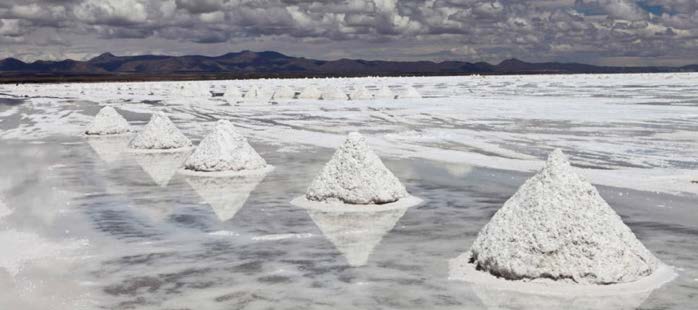
Evaporating cones of salt—part of the lithium mining process in Chile. To maintain the same system globally, the capitalist system, in which there is an energy-intensive production and consumption pattern, means more extractivism, more sacrifice zones, and more disruptions in countries of the Global South.
So, for example, Indonesia introduced a ban on export of raw nickel. Zambia introduced a similar ban on the export of raw copper, and others are thinking of going down the same road. I heard that the Latin American countries, the Lithium Triangle, Chile, Bolivia and Argentina, are considering the idea of a lithium cartel like OPEC. But it comes with challenges because you operate within that capitalist, imperialist system where there is an ongoing domination by the North over the South, and that manifests clearly. When Indonesia introduced that ban, the European Union were not happy with them. They were furious. How dare Indonesia ban the export of cheap raw nickel? They took them to the World Trade Organisation. The case is still ongoing. It also raises the question, who are the ruling classes who are doing this? Are they really doing it for the people? So, we need a class analysis.
Nevertheless, I would support such moves by Indonesia, even though it isn’t perfect. There is no perfect solution, but I think resource nationalism is needed in some cases.
Localisation and decentralisation
It’s not that I don’t like localisation initiatives. It’s that I don’t like the idea that they are going to be the only solution for our problems. I still believe in the role of the state and the role of public investments and alternatives. I believe that there is a space for decentralised initiatives, either cooperative or community-owned, but given the climate emergency that we have, I feel that the state needs to play a bigger role. Maybe that’s easier said than done. Because we need to democratise the state. We need to decolonise the state. Recapture the state. So, really, it concerns the agenda of justice and liberation.
Towards a strategy
In the context of North Africa, Algeria, Tunisia, Morocco and Egypt, in the questions around climate, environment and energy, we need to shift the narrative to tackle the mainstream narrative around the climate, ecological and energy crisis in the region. It’s a narrative that is really disempowering. It is based on more capitalism, more austerity, more privatisation, more enclosures and more land grabbing. We need to, first of all, challenge that narrative and re-imagine and analyse in a different way what is happening.
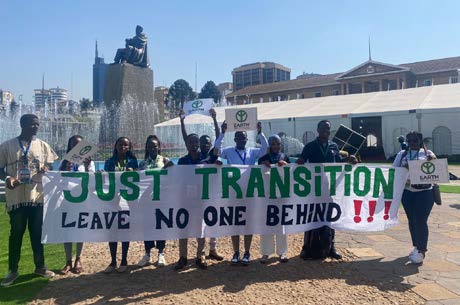
The just transition is a class issue, so it means we need to talk about capitalism. We need to talk about who owns the resources of society and who gets to decide how they are used. This is the question of power.
And then we need to analyse how capitalism works. We need to analyse its dynamics and how it reproduces itself in the name of sustainability and green transition. Who owns what? Who gets what energy? For whom? Food for whom? Who loses and wins? We don’t just ask these questions for the sake of asking them. We’re asking them so we can understand the dynamics of the system that we are fighting, so we can have strategies to fight that system.
Strategies need to be built through building power, through organising. We need coalitions of different groupings of working people, not just the urban, industrial working class, but also the peasantry, pastoralists, precarious workers, and social reproductive workers. We need to create those intersections and solidarity between them. The idea of creating that coalition of working people is to shift the balance of power. That cannot just happen on the local or national level. It needs to happen at a regional and international level. That’s the idea. We need to recapture power, build power. That takes time. Revolutions take time.
Hamza Hamouchene is a London-based Algerian researcher and activist. He is currently the North Africa Programme Coordinator at the Transnational Institute (TNI).